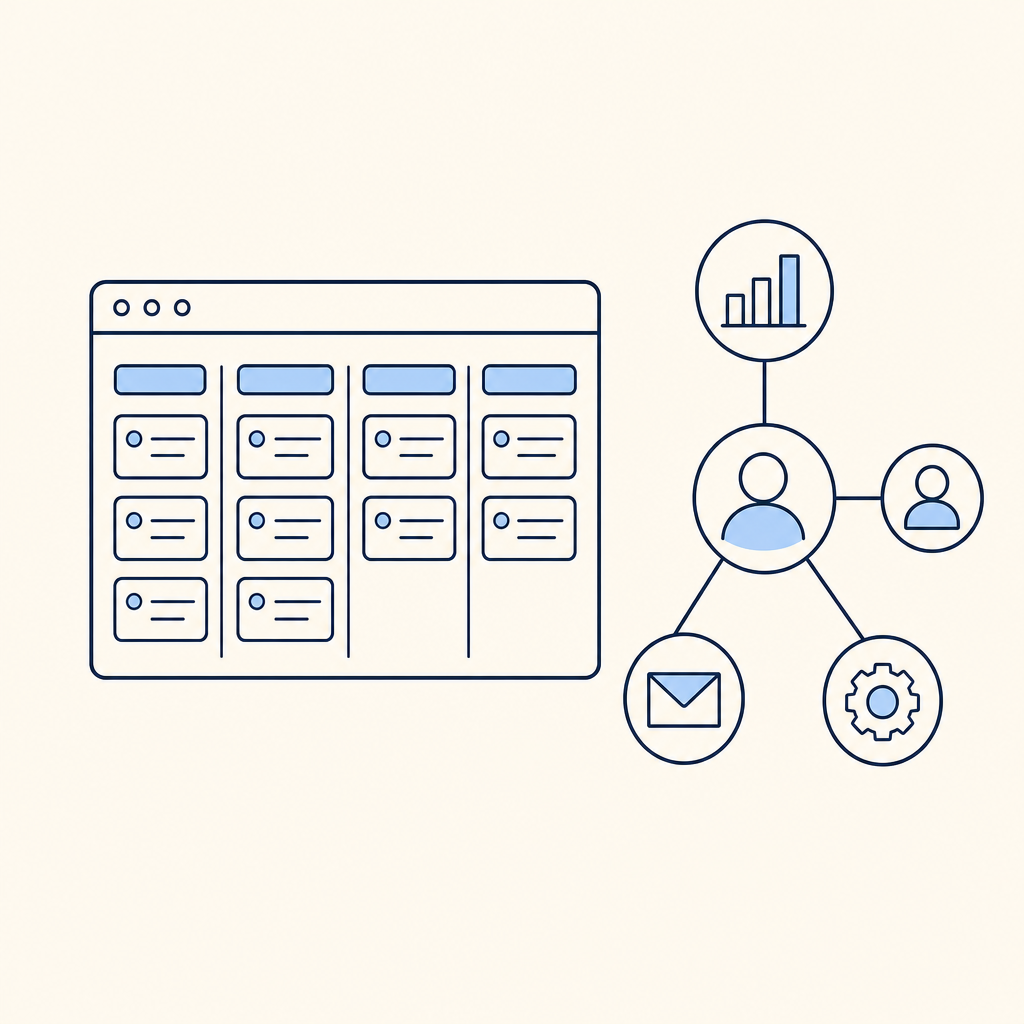
Teams look for Pipedrive competitors when a simple pipeline stops being the whole job. Reps still like the visual deal board, but the business now needs custom records, marketing alongside sales, or AI that works from real customer context, and each of those tends to mean another add-on. The six options below are ranked on how well they handle that next stage.
- Attio: Best for a go-to-market team that wants a flexible data model and AI that works from the first week.
- HubSpot: Best for a growing team that wants marketing, sales, and service on one contact database.
- Close: Best for a phone-and-email-heavy sales team that wants calling, SMS, and email inside every record.
- Freshsales: Best for a small or mid-sized team that wants a built-in phone and AI lead scoring in one tool.
- Zoho CRM: Best for a cost-conscious team that wants broad functionality and may adopt other Zoho apps.
- monday CRM: Best for a team that already runs projects on monday and wants sales on the same boards.
What to weigh when leaving Pipedrive
Most switches succeed or fail on a handful of questions.
What does the pipeline need to do beyond moving deals? A drag-and-drop board covers a simple sales process well. Once you sell through partners, track subscriptions, or manage investors alongside customers, you need a CRM that lets you create your own record types instead of stretching custom fields.
Which add-ons are you paying for? Lead generation, campaigns, and projects are separate line items in many CRMs. Add up what you pay for today and compare it with a plan where those tools are included.
Where does the AI get its context? An assistant that reads your emails, calls, and records can answer real questions on day one. One that starts empty needs your team to feed it first.
How much of the activity is logged for you? Calls, emails, and meetings that land on the record without a rep typing them up decide whether the data is still trustworthy a year from now.
The 6 best Pipedrive competitors
1. Attio
Best for: A technical go-to-market team that wants its CRM shaped around its own business and AI that works from day one.
Attio is the agentic CRM that runs the work behind every win. Standard objects like people, companies, and deals sit alongside custom objects a team can create itself, so the system matches how the business sells. Ask Attio searches across calls, emails, notes, and records to answer questions, draft follow-ups, and update the pipeline, and Workflows automate routing, alerts, and enrichment on a visual canvas. Lists give a kanban view for teams that want to keep a Pipedrive-style board.
Key features:
- Custom objects and a flexible data model a non-technical user can change.
- Ask Attio and AI Attributes available on every plan.
- Email and calendar sync that creates and enriches records automatically.
- A REST API, App SDK, and MCP server for teams that want to build on top.
Considerations:
- Built around go-to-market work, so marketing automation and a help desk need other tools alongside it.
- Best suited to teams comfortable shaping their own data model.
Pricing: Free for up to three seats, with paid plans per seat. See attio.com/pricing for current tiers. Learn more: attio.com
2. HubSpot
Best for: A growing team that wants marketing, sales, and service in one platform and values a shorter learning curve.
HubSpot’s free CRM core, with unlimited users, makes it easy to start, and its hubs add marketing automation, sales sequences, and a help desk when the team is ready. The shared contact database means marketing and sales work from the same records, and a large app marketplace covers most integrations.
Key features:
- A free CRM core with contacts, companies, deals, and tickets.
- Marketing, Sales, and Service Hubs on one contact database.
- A visual workflow builder with a template library.
- Agent Hub for prospecting, support, and data questions.
Considerations:
- Costs climb as teams add hubs, seats, and contacts.
- Agent Hub usage is billed on consumption on top of the seat price.
Pricing: Free CRM with unlimited users. Paid Sales, Marketing, and Service Hub tiers priced per seat, with AI usage billed by consumption. Learn more: hubspot.com
3. Close
Best for: A sales team that lives on the phone and in email and wants every touch logged on the record.
Close was built for outbound-heavy teams. Calls, email, and SMS all happen inside the lead record, and calls are logged, recorded, and transcribed automatically. Power and predictive dialers speed up high-volume calling, and Chloe, its AI agent, can transcribe calls, research accounts, and handle qualification.
Key features:
- A built-in dialer with automatic call logging, recording, and transcription.
- Email and SMS sequences that run from the same record.
- Smart Views that turn filters into a daily work queue.
- Workflows for multi-step, multi-channel cadences.
Considerations:
- Focused on sales outreach, so marketing and service work happens elsewhere.
- AI is billed on usage credits that scale by plan.
Pricing: Tiered per-seat plans. See close.com/pricing for current tiers. Learn more: close.com
4. Freshsales
Best for: A small or mid-sized sales team that wants calling, email, and AI lead scoring without stitching tools together.
Freshsales comes from Freshworks and is designed to be easy to adopt. Deals sit in a kanban pipeline, a built-in phone lets reps call from the browser, and sequences combine email, calls, and tasks. Freddy AI scores leads and tags open deals by likely outcome.
Key features:
- A kanban deal pipeline with built-in deduplication.
- A browser and mobile phone with automatic call logging.
- Sequences that mix email, call, SMS, and task steps.
- Freddy AI lead scoring and deal insights on the Pro plan.
Considerations:
- Freddy works from data already in the CRM, so it needs clean records to be useful.
- AI forecasting is limited to the Enterprise plan.
Pricing: Tiered per-user plans. See freshworks.com/crm/pricing for current tiers. Learn more: freshworks.com/crm
5. Zoho CRM
Best for: A cost-conscious team that wants a broad feature set and may adopt other Zoho apps over time.
Zoho CRM covers lead management, sales automation, forecasting, and analytics at a price that suits smaller budgets. Its Zia assistant adds predictions and recommendations, and native links to the wider Zoho suite make it a natural hub for teams already using those apps.
Key features:
- Lead scoring, routing, and automated nurturing.
- Blueprint to enforce a sales process stage by stage.
- Zia AI for predictions, insights, and send-time recommendations.
- Canvas for no-code redesign of layouts and list views.
Considerations:
- The breadth of settings takes time to learn.
- The interface is less streamlined than newer CRMs.
Pricing: Tiered per-user plans from entry level to enterprise. Learn more: zoho.com/crm
6. monday CRM
Best for: A team that already plans work on monday and wants sales tracked on the same boards.
monday CRM is part of a flexible, no-code work platform. Leads, accounts, and deals live on customizable boards that connect to the rest of a company’s projects, so handoffs between sales and delivery stay visible. AI agents cover lead sourcing, pipeline monitoring, and meeting prep.
Key features:
- Code-free boards with table and kanban views.
- Deal insights that flag inactive or slowing deals.
- Quotes and invoices generated from deal records.
- AI agents for lead sourcing, pipeline health, and meeting briefs.
Considerations:
- Record limits and AI credits scale by plan, so check them against your volume.
- Sales depth is lighter than in CRMs built only for selling.
Pricing: Tiered per-seat plans. See monday.com/crm/pricing for current tiers. Learn more: monday.com/crm
How to pick between them
A go-to-market team that wants to shape its own CRM and have AI working from the first week gets the most from Attio. A team that wants marketing and sales under one roof will feel at home in HubSpot. Close suits a team that sells by phone, Freshsales a small team that wants calling and scoring included, and Zoho a team watching budget. monday CRM fits a team that already runs on monday boards.
For the general criteria behind a CRM choice, our guide to the best CRM software covers what to weigh beyond Pipedrive alternatives.
FAQs
How hard is it to migrate away from Pipedrive? Most platforms import deals, people, and organizations from CSV, and several offer migration assistants. The harder work is deciding which custom fields and automations are still worth carrying over, so audit those before moving anything.
Can I keep Pipedrive’s visual pipeline after switching? Yes. Every CRM on this list has a kanban-style deal view, so reps keep the board they know while the system underneath gains more structure.